When a heavy-duty modular drawer cabinet holds 400 lb (181 kg) per drawer at 100% full extension, safety engineering cannot rely on technician habits alone. Extending two fully loaded upper drawers simultaneously projects 800 lb (362 kg) more than two feet forward of the cabinet’s front toe line—generating enough overturning torque to tip an unanchored eye-level steel cabinet straight onto the operator.
Engineered for 400 lb (181 kg) per-drawer uniform static load, 100% full extension, and single-drawer anti-tip interlock operation; cycle-load test sheets available per project.
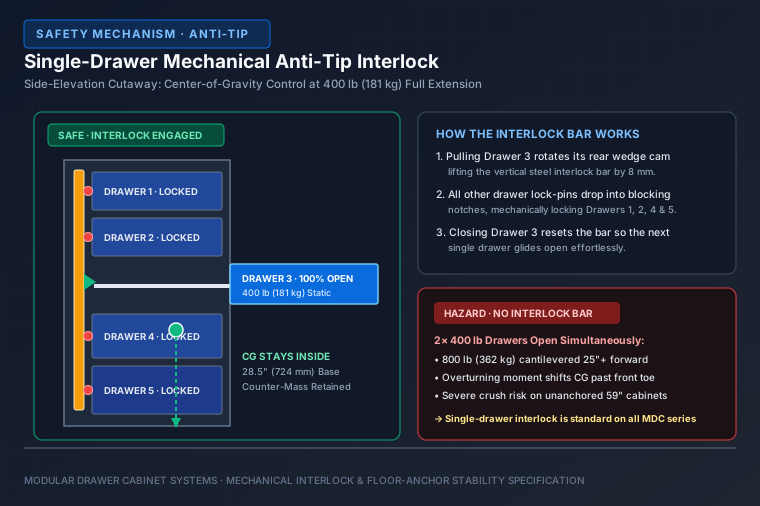
The Tip-Over Physics of 400 lb Full-Extension Cabinets
A standard 59” eye-level MD-9D400 has a footprint depth of 28.5” (724 mm) and a full-extension drawer stroke of 25.5” (648 mm). Consider the moment balance around the front base edge:
- Single Drawer Open (Interlock Engaged): One extended 400 lb drawer is counterbalanced by the steel cabinet shell (~450 lb empty) plus the remaining eight closed drawers seated behind the front fulcrum. The combined center of gravity remains safely inside the 28.5” base footprint.
- Two or More Drawers Open (Un-Interlocked Cabinet): Pulling a second 400 lb drawer out—especially from an upper shelf while lower drawers are lightly loaded—shifts the combined center of gravity past the front base edge, initiating an irreversible forward tip-over.
How the Mechanical Single-Drawer Interlock Operates
Unlike fragile plastic latches or electronic solenoids that fail when power drops, industrial modular cabinets use a purely mechanical vertical steel interlock bar mounted along the rear interior upright:
- Neutral Closed State: With all drawers pushed home, every drawer’s rear cam pin sits aligned with its entry slot along the vertical lock bar.
- Single-Drawer Release: Pulling any single drawer rotates its wedge cam, elevating the vertical steel bar by ~8 mm.
- Positive Multi-Drawer Block: That 8 mm vertical shift slides solid steel blocking shoulders directly in front of every other drawer’s rear cam pin—physically preventing a second drawer from pulling open until the active drawer returns fully closed.
- Central Key Lock Integration: Turning the top cylinder lock pins the vertical interlock bar in the locked position so one key secures all 5, 7, or 9 drawers simultaneously.
Additional Stability Rules for Shop-Floor Safety Audits
Even with a mechanical single-drawer interlock installed as standard across every MD-5D400, MD-7D400, MD-9D400, MD-CNC40, and MD-MOB400, EHS teams enforce four best practices:
- Load Heavy Parts Low: Place dense dies, hydraulic motors, and bulk bolts in the bottom 7”–10” drawers and lightweight O-rings, sensors, and gauges in upper 3” drawers.
- Anchor Standalone 59” Units: Bolt standalone eye-level cabinets to the concrete slab through the factory forklift-base floor tabs, or bolt adjacent cabinets together side-by-side into a rigid multi-cabinet bank.
- Never Defeat Interlocks for “Dual Picking”: Train technicians never to tape or remove rear interlock cams; if two operators frequently pick simultaneously, deploy two adjacent cabinets rather than bypassing the lock bar.
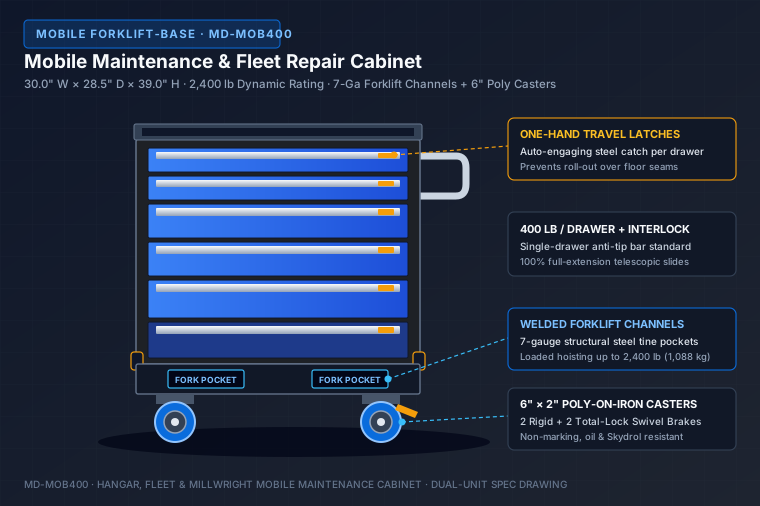
- Require Travel Latches on Mobile Units: On mobile carts such as the MD-MOB400, combine the single-drawer interlock with spring-loaded individual drawer travel latches so drawers cannot slide open over floor seams or ramps.
Verify EHS & Interlock Specs for Your Facility
Need cycle-load test sheets, concrete anchor hole templates, or keyed-alike safety lock hierarchies for a plant EHS audit? Request documentation with your 15-Minute Formal Quote brief.
Standard & Custom-Engineered Models
59" 9-Drawer 400 lb/Drawer Heavy-Duty Modular Cabinet
Flagship 59" (1,500 mm) 9-drawer heavy-duty cabinet with 400 lb (181 kg) per-drawer load rating, 100% full extension slides, and anti-tip interlock for MRO parts walls.
Full Datasheet →